

Our Changing World for Thursday 30 July 2009
Cousin Marriage
The marriage of first cousins is a practise that is highly stigmatised in many countries yet greatly favoured in others, and it was an issue that greatly worried Charles Darwin, who married his first cousin Emma Wedgewood. It has also been exercising the minds of University of Otago zoologist Hamish Spencer, and University of Massachusetts political scientist Diane Paul. They write about the history and genetics of the issue in their recent paper 'It's Ok, We're Not Cousins by Blood": The Cousin Marriage Controversy in Historical Perspective' (DB Paul and HG Spencer 2008 PLoS Biol 6(12): e320. doi:10.1371/journal.pbio.0060320).
Hamish Spencer spoke on the issue of cousin marriage this week in Auckland as part of the 'Seasons of Life lecture series 2009: Darwin's legacy'which takes an eclectic look at evolution, and is hosted by the Liggins Institute at the University of Auckland. The lecture series is free and open to the public but bookings are essential.
Pollen Detective
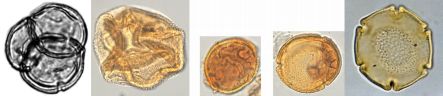
Various pollen grains: from left to right Dracophyllum, Coprosma (three views), and Nothofagus (image: Dallas Mildenhall).
Pollen grains and spores are tiny, long lasting and because they readily adhere to almost any surface, can be found just about everywhere. They are also characteristic of both time and place, so just one type of pollen grain or spore can connect a suspect to the scene of a crime.
Dallas Mildenhall is a forensic palynologist at the Institute of Geological and Nuclear Sciences where he uses pollen grain and spores to help solve crimes and rape cases.
Restoring Secretary and Resolution islands
Two weeks ago Resolution Island, which lies at the entrance to Dusky Sound in Fiordland, was in the news as the epicentre of a magnitude 7.8 earthquake. Six years ago, Secretary Island, at the entrance to Doubtful Sound, was in the news for much the same reason, with a 7.1 magnitude earthquake bringing down many slips on the island. During both earthquakes, a handful of Department of Conservation staff were among the few people in this remote uninhabited part of the country. They were in the area tackling the sizeable problem of introduced deer and stoats on two of the country's largest islands: Secretary Island is over 8000 hectares in size, while Resolution is more than 20,000 hectares. Earlier this year in Te Anau Alison Ballance caught up with some of the key members of DoC's Fiordland Islands restoration team, including Kerri-Anne Edge, Megan Willans, Peter McMurtrie and Dave Crouchley. The Fiordland Islands restoration project was recently voted one of the top 25 Australasian restoration projects.
Sea Ice Cores
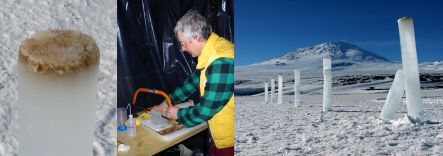
Microorganisms on bottom of sea ice core; Ken Ryan preparing ice cores; view of various ice cores (images: Ken Ryan).
While Antarctica's sea ice may seem a rather inhospitable place for life, it provides a unique habitat for a dense community of micro-organisms, such as algae, bacteria, and archaea species.
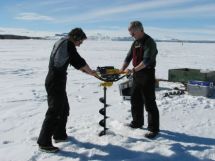 These microbial communities constitute a major food source for local marine ecosystems. In a warming planet, understanding what lives in the sea ice is taking on an increasing importance. Ken Ryan and his students (right) from Victoria University are frequent spring and summer visitors to Antarctica, where they drill cores into the sea ice to see what lives there.