

Our Changing World for Thursday 27 August 2009
2009 MacDiarmid Young Scientists of the Year
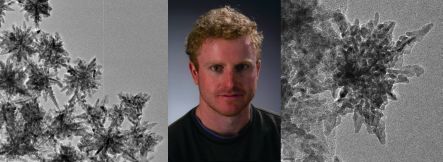
John Watt and his palladium nanocrystals (images: John Watt)
The MacDiarmid Young Scientists of the Year awards recognise excellence in New Zealand's emerging researchers. After three rounds of rigorous judging, the 19 finalists for 2009 were selected from a range of fields - from conservation techniques and textile colourants to new therapies to treat diseases such as muscle wastage and glaucoma.
Ruth Beran met with the winner for 2009, John Watt from Victoria University of Wellington, who is creating "nano-crystals" of palladium metal in a way that minimises the amount of metal used while also increasing the catalytic performance.
New Collection Facility at Te Papa
Te Papa Tongarewa is the National Museum of New Zealand. One of its roles is to look after some of the country's important natural history collections, such as fish, marine mammals and birds. These collections must be housed safely and securely, a big ask in the earthquake-prone capital, but a challenge which the new vertebrate collection facility is more than capable of meeting. Andrew Stewart is collection manager for fishes, and he took Alison Ballance on a tour of the nearly completed facility. Andrew Stewart featured on Our Changing World two weeks ago talking about the diversity of fishes in the New Zealand region.
Air Particulates
At GNS Science'sNational Isotope Centre, protons are being accelerated with a voltage of 2.5 million volts in a particle accelerator till they travel at a speed of 20% to 30% the speed of light. They are then used to measure and analyse the composition of a range of materials, including the pollution floating in air.
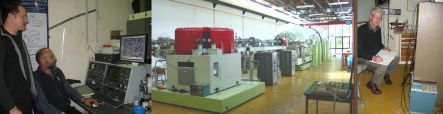
Two-thirds of New Zealanders live in urban areas that experience episodes of degraded air quality. To effectively manage air quality, the composition of air particulates needs to be determined so the sources that caused the pollution can be identified. This is because air pollution can be caused by both natural processes, which are often hard to prevent, and by people. GNS Science's Perry Davy (top left - standing), Bernard Barry (top right) and John Futter (top left - sitting) explain how a particle accelerator (top centre) works, and how air pollution can be analysed.
Zebrafish and Genetic Research

Scientists who want to discover the decision-making process of cells in embryos often turn to animal models such as mice or sheep. But there's a catch - the embryo is hidden away inside its mother. Which is where a small tropical fish with transparent eggs and embryos comes into the picture, and why the Department of Pathology at the University of Otago is now home to hundreds of aquariums (above right) and thousands of zebrafish (above left).
Alison Ballance visited the newly opened Zebrafish Facility (PDF) where Julia Horsfield and PhD student Jenny Rhodes from the Chromosome Structure and Development Group in the Dunedin School of Medicine explained how zebrafish are helping in genetic research into developmental diseases and human cancers, especially breast cancer.

Transparent zebrafish eggs and larvae (images: University of Otago)