

Our Changing World for Thursday 22 October 2009
Astronauts and the Elderly

Jorge Serrador at the NASA Ames human centrifuge, and floating upside down on the NASA parabolic flight plane during zero gravity (image: Jorge Serrador)
It seems pretty obvious that we need blood flowing to our brains and that a reduction in brain blood flow can cause light headedness or even fainting. But how is the process regulated?
Putting people in giant centrifuges or measuring them after parabolic flights, are just some of the ways that Jorge Serrador from Harvard Medical School has been studying the impacts that the body's balance system has on brain blood flow.
As he explains to Ruth Beran, he has also been looking at two very different groups of people in his research: astronauts and the elderly.
Honeydew Forest Ecosystems
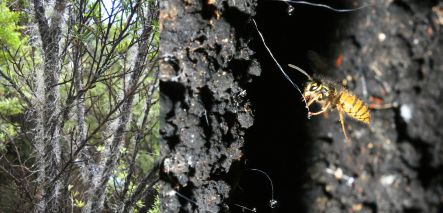
A dense mass of honeydew droplets and threads (image: Mike Taylor) and European wasp feeding on a honeydew droplet (image: Robert Brown)
If you go down to the woods today, and certainly if you go down to the beech forests of the northern South Island, you'll see tree trunks covered in shiny black droplets, black sooty mould, and there will be the distinctive sweet smell of honey. These are New Zealand's honeydew beech forests, in which sugar is a major feature of the ecosystem. Honeydew is a sugary exudate produced by endemic scale insects (Ultracoelostoma spp.), and native species such as kaka, bellbird, tui, lizards and native insects feast on the sugary bonanza. As University of Auckland ecologist Jacqueline Beggs explains, however, introduced European wasps also have a fondness for sugar, and by ransacking the abundant sugar supply and eating native insects for protein they have markedly changed the ecosystem.
The honeydew forest ecosystem turns out to be much more complex than anyone first imagined, at both a macro and a microbial level. Recent research has explored areas such as the aromatic chemistry of the honeydew odour, while wine and fermentation specialist Matt Goddard has looked at the community of yeasts which live on the sugars.
Antarctic Marine Larvae
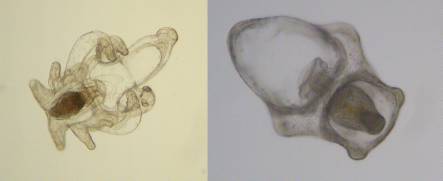
Larval stage of the starfish Bipinnaria (images: University of Auckland)
Scientists trying to study the diversity of marine life in Antarctica's Ross Sea face more than a few challenges. For a start, their study animals are hidden beneath metres of sea ice. But this difficulty hasn't deterred New Zealand scientists taking part in the Latitudinal Gradient Project in Antarctica.
Mary Sewell from the University of Auckland is interested in the larvae of creatures such as polychaete worms and ribbon worms, that live on the sea floor. The larvae of these bottom-dwelling animals live in the water column as part of the meroplankton, often a long way from their parents. Trying to identify the larvae and work out which larvae belong to which adult can be almost impossible, which is why Shane Lavery has been called on to bring molecular identification techniques to the project. And it turns out the diversity of marine larval life is much more than either of the biologists expected.
Genetic Screening of Plants
Images: Plant and Food Research
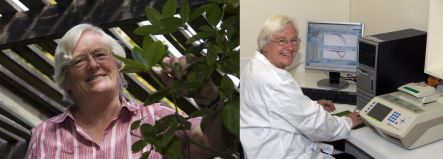
When you think of DNA fingerprinting, you generally think of criminal investigation. But molecular biologist Sue Gardiner (above) from Plant and Food Research is using genetic markers to screen for beneficial traits in plants.
Her research is helping to breed new varieties of fruits with specific characteristics, such as pest and disease resistance, novel flesh colour and new flavours. She was also recently awarded the 2009 Outstanding International Horticulturist Award for her contribution to apple research.
Sue Gardiner shows Ruth Beran through the laboratories and explains the process of genetically screening plants.