

Our Changing World for Thursday 12 November 2009
The Use of Human Bodies at the Otago Medical School
Human bodies have a long history of use in medical schools, to teach trainee doctors about anatomy and dissection. There has been a trend in some overseas medical schools away from the use of bodies, but Otago Medical School still believes in the value of medical students learning anatomy on real bodies, and runs a formal body bequest programme.
Alison Ballance talks with University of Otago anatomy professors Helen Nicholson and Mark Stringer who both feature in doctor and film-maker Paul Trotman's new documentary. 'Donated to Science - humanity is more than skin deep' follows a group of medical students at the Otago Medical School over two years as they dissect human bodies, and also features interviews with the people who chose to donate those bodies.
The film airs at 9.30 pm on TV3 on Wednesday 18 November. Kim Hill will be interviewing Paul Trotman on Saturday 13 November.
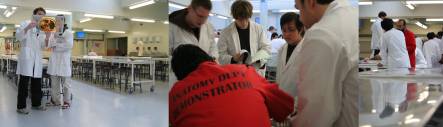
(Images: Clive Copeman/PRN Films)
Nanowhiskers
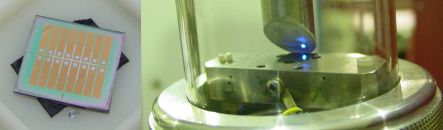
A silicon chip device chip and a blue pixel from a nanowhisker device (image: GNS Science)
When a wafer of silicon is slowly heated under high vacuum conditions, the structure of the silicon rearranges itself, and tiny nanowhiskers are formed. Like a pyramid, the tips of these nanowhiskers are sharp, and can be made to emit electrons, a potentially very useful property for devices like computer displays and widescreen televisions.
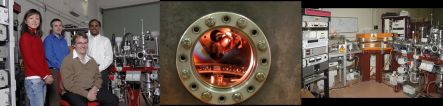
The team, inside the electron beam annealer, and the ion implanter (image: GNS Science)
Scientists at GNS Science are creating these nanowhiskers, and Ruth Beran meets team leader Andreas Markwitz (seated) as well as Vivian Fang, Damian Carder, and John Kennedy (standing left to right) to find out how nanowhiskers are made and tested.
Biomineralisation
Hard biological structures like teeth, shell and bone are formed via biomineralisation and the process is widespread in nature. However, scientists are still not quite sure how it actually works.
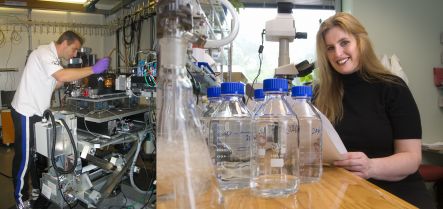 (image: Victoria University of Wellington)
Conrad Lendrum from Industrial Research Limited (above left) and Kate McGrath from Victoria University (above right), both McDiarmid Institute for Advanced Materials and Nanotechnology scientists, would like nothing more than to be able to replicate the process of biomineralisation in the lab, but as Ruth Beran finds out, that may not happen for some time yet.
Ocean Science Series at the Leigh Marine Laboratory
The Leigh Marine Reserve lies a hundred kilometres north of Auckland - New Zealand's first marine reserve, it's officially known as the Cape Rodney to Okakari Point Marine Reserve, and has been an outstanding success. Overlooking the reserve, and often undertaking research within its boundaries, is a venerable marine science institution - the University of Auckland's Leigh Marine Laboratory.
In the first of a weekly series featuring the Leigh Lab, director John Montgomery talks with Alison Ballance about the history of the lab, plans for the future, and his own research with the electro-sensory abilities of sharks.