

Our Changing World for Thursday 2 September 2010
UV Dosimeters

UV dosimeters - one held up to the sun, the other worn around the wrist as participants did in the study (left image: Dave Allen, NIWA)
Going out in the sun is a double-edged sword. Ultraviolet radiation can cause skin cancers, but insufficient exposure to sunshine can lead to low levels of vitamin D.
The sun's ultraviolet rays produce most of the vitamin D your body needs and it's important for bone mineralization -- a lack of it can cause rickets. But vitamin D deficiency can cause far greater problems, with recent studies suggesting potential links to a wide-range of diseases, from multiple sclerosis to rheumatoid arthritis.
Tony Reeder and Jan Jopson from the University of Otago and NIWA's Richard McKenzie have been measuring people's exposure to UV using personal dosimeters. Ruth Beran went to meet them, and gave back two devices which she and co-presenter Alison Ballance had worn for a week during winter to find out how each of them fared in the UV stakes.

From left to right: Richard McKenzie, Jan Jopson andTony Reeder(right image: CSNZ)
The Acid Test - A Feature on Ocean Acidification
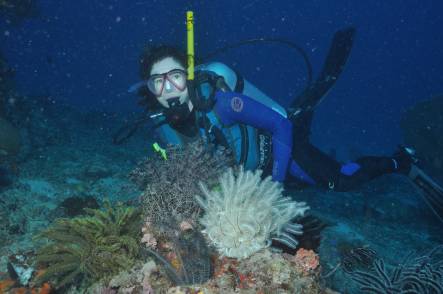
In this special feature on ocean acidification, producer and diver Alison Ballance finds that coral reefs, such as the Great Barrier Reef pictured here, are already experiencing the effects of increasing acidity. (Image: M. Francis)
Ocean acidification has been called 'The Other Carbon Dioxide Problem'. We're all familiar with global warming and the effects that increasing carbon dioxide emissions are having on the atmosphere, but what few people realise is that about 30% of carbon dioxide emitted by human activities since the beginning of the industrial revolution has been absorbed by the world's oceans. And rising levels of carbon dioxide in seawater are beginning to affect ocean chemistry, and as a consequence, marine life.
In this Our Changing World feature Alison Ballance talks with chemists and biologists about ocean acidification, what it is and what their experiments are beginning to reveal about its possible effects in southern hemisphere waters.
Many of the scientists featured in The Acid Test are meeting at the University of Otago on Monday 6 September for a workshop titled 'Ocean Acidification in the South Pacific' - it is the fourth such meeting in New Zealand, and one of a growing number of international conferences being held on the subject. Significant workshops were held in Paris in 2004, Monaco in 2008, with one being planned for California in 2012.
The Royal Society of New Zealand published an emerging issues paper on ocean acidification in 2009, following on from a similar position paper published by the Royal Society in 2005. Recent articles on the subject have featured in The Economist, Science (pdf) and Scientific American.
