

Our Changing World for Thursday 8 October 2009
Central Otago Giant Skink Reserve
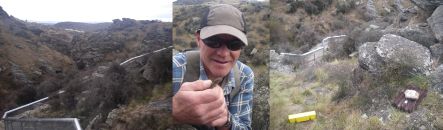
Central Otago. Officially it's a desert. It's almost devoid of native trees, and instead has wilding pines, numerous weedy wild flowers … and rabbits. Grant Norbury (above, holding a common gecko) is a dryland ecologist, who's day job with Landcare Research sees him trying to understand how plants and animals interact in this environment. He's also a trustee of the Central Otago Ecological Trust (COET), which is creating a predator-free reserve for giant skinks, of which there are two species: grand skinks and Otago skinks. COET is a community-led conservation project that aims to reintroduce fauna such as Otago skinks that have been lost from the Alexandra basin, and restore the native vegetation in a threatened dryland ecosystem.
Alison Ballance heads into the hills near Alexandra to take a look at the Mokomoko Dryland Sanctuary and its new predator-proof fence (above left; images: Alison Ballance).
Climate Change, Heat Waves and Health
Historically, people in New Zealand haven't had to worry too much about heat.
However, as the planet warms with climate change, natural hazards such as heat waves are predicted to increase in frequency, duration and intensity, and that may mean more heat-related deaths, as well as impacts on livelihoods and infrastructure.
Glenn McGregor from the University of Auckland is using models to look into what the future might hold in this regard, for example, whether there may be an alteration of the geographical distribution of heat waves.
New Generation Animal Tracking
It's not often that the world of a university physicist intersects with that of zoologists, but the University of Otago's Tim Molteno has found that inventing devices for tracking animals brings the two worlds together quite comfortably. Working with various collaborators, including electronics student and bird photographer Keith Payne, he's developing new kinds of animal tracking tags using novel electronics and unique GPS signal processing algorithms. One kind of tag will use mobile phone networks, while tiny ultra-fast geo-locators will use GPS technology. The university team, which received funding from the Foundation for Research Science and Technology (FRST) this year, is collaborating with David Thompson of NIWA in another FRST-funded project satellite tracking albatrosses in the subantarctic, a project which featured on Our Changing World last year.
Eye movements of Eye Witnesses
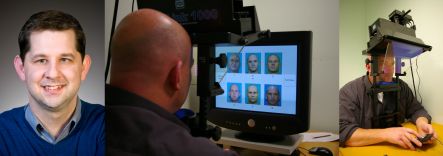
Matthew Gerrie and a participant in the eye tracker experiment picking faces from a lineup (image: VUW)
The Innocence Project New Zealand is a joint venture between Victoria University and the University of Otago and investigates possible cases of wrongful conviction in the New Zealand legal system.
Victoria University's Matthew Gerrie leads the project and he is particularly interested in how witnesses remember - or sometimes misremember - details from a crime scene. He recently won the Science and Our Society category of the 2009 MacDiarmid Young Scientists of the Year Awards for his research which uses infrared eye tracking technology to improve the process of identification by eye witnesses of criminals in police lineups.
Ruth Beran met with him to find out how well she can pick out a criminal from a lineup and in the process gets an eye test with a difference.
Listen here for an interview with Matthew Gerrie on Sunday Morning with Chris Laidlaw.